
Weight Loss Is Not The Same As Fat Loss

By Coach Charles Remington
After 35 years of coaching and more than 19,000 clients, I've discovered something most people never hear when they start a weight loss program:
Weight loss and fat loss are not the same thing.
A client can lose 15 pounds and actually look worse.
Another client can lose only 5 pounds and look dramatically better.
One may have lost muscle, water, and metabolic function.
The other may have lost body fat while preserving lean muscle.
The scale doesn't know the difference.
That's why I've spent most of my career teaching clients to stop chasing weight loss and start pursuing body composition.
The scale gives you a number.
Body composition tells you a story.
And if you're over 40, that story becomes even more important.
As we age, muscle loss accelerates. Recovery changes. Hormones change. Metabolism adapts. If your strategy focuses only on getting lighter, you can accidentally sacrifice the very tissue responsible for helping you maintain your results.
I've seen it happen thousands of times.
Someone proudly tells me they've lost 20 pounds.
Then I look at their body composition.
Their metabolism has slowed.
Their muscle mass has dropped.
Their energy is lower.
And six months later, most of the weight has returned.
Not because they failed.
Because the system failed.
One of the foundational principles of Metabolic Body Optimization is simple:
The medication is a tool. The system determines the outcome.
The same is true for diets, supplements, exercise programs, GLP-1 medications, peptides, and even calorie counting.
Tools can be useful.
But tools are not systems.
Without a system designed to preserve muscle, regulate metabolism, and create a sustainable lifestyle, most people eventually find themselves right back where they started.
That's one of the reasons I developed the Glyco-Cycle® System.
For decades I've taught that successful fat loss requires structure.
Not starvation.
Not guesswork.
Not another quick fix.
The goal isn't simply to make the scale go down.
The goal is to lose body fat while protecting lean muscle.
Because muscle isn't just about appearance.
Muscle helps regulate blood sugar.
Muscle supports insulin sensitivity.
Muscle influences resting metabolic rate.
Muscle affects how we age.
When muscle is lost during a diet, the consequences extend far beyond aesthetics.
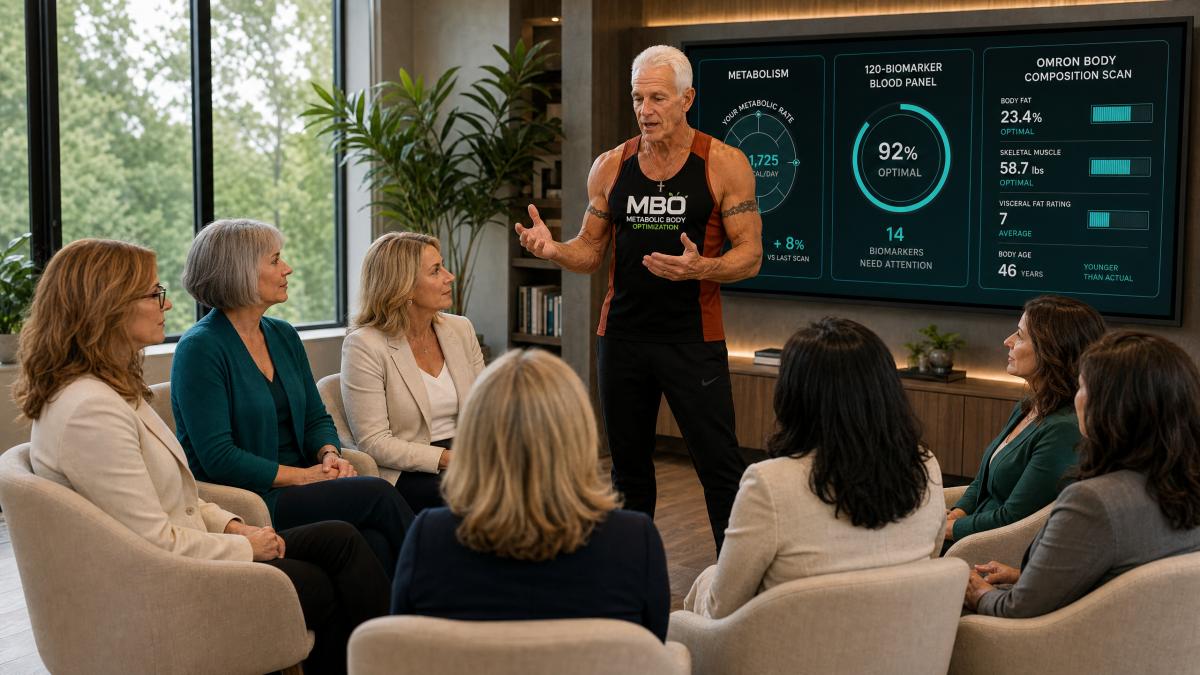
This is why body composition tracking is such an important part of the MBO process.
At Metabolic Body Optimization, we don't just measure weight.
We measure what was actually lost.
Body fat percentage.
Lean muscle mass.
Visceral fat.
Hydration status.
Progress over time.
Because when you measure the right things, you can make the right decisions.
One of my favorite sayings is:
The scale measures weight. The Omron measures progress.
Most people are shocked when they discover that the scale can move very little while their body composition improves dramatically.
Their waist gets smaller.
Their clothes fit better.
Their energy improves.
Their body fat decreases.
Yet the scale barely changes.
That's not failure.
That's progress.
In today's world, many people are also exploring advanced tools such as GLP-1 medications, peptides, hormone optimization, and biomarker testing.
Again, these can be valuable tools.
But they do not replace a system.
A medication can reduce appetite.
It cannot teach structure.
A peptide can support recovery.
It cannot teach consistency.
A supplement can support health.
It cannot create accountability.
That's why every MBO program is built around a complete strategy that includes body composition tracking, structured nutrition, accountability, and when appropriate, advanced biomarker testing.
Because your body is constantly leaving clues.
And your blood often holds the evidence.
After coaching thousands of clients, I've learned that successful transformation isn't about becoming lighter.
It's about becoming healthier, stronger, and more metabolically efficient.
If you're serious about changing your body, ask a better question than:
"How much weight can I lose?"
Ask:
"What am I losing?"
Because when you focus on body composition instead of scale weight, you're no longer chasing a number.
You're building a body that can maintain the result for years to come.
And that's where real transformation begins.


Comments