
Biomarker Testing for Body Composition Goals

Table of Contents
Why Your Scale Lies About Body Composition
How to Lose Fat While Keeping Muscle
What a Metabolic Blood Panel Analysis Reveals
The Body Leaves Clues, If You Know Where to Look
Biomarker Testing for Body Composition Goals
Why Your Scale Doesn't Tell the Whole Story
Your weight this morning tells you only part of what changed in your body.
I've worked with nearly 19,000 clients over 35 years, and this is one of the first things I want people to understand: weight loss and fat loss are not the same thing.
A scale can't tell you whether the weight you lost came primarily from fat, muscle, water, or some combination of all three.
That's important because I've never believed the goal should simply be to make someone lighter.
The goal is to improve body composition.
Most weight-loss programs focus on one number because it's simple: How many pounds did you lose?
But that's not enough information.
Someone can lose weight while also losing valuable muscle. The scale may show progress while the person's body composition tells a very different story.
That's why at Metabolic Body Optimization, we don't simply ask:
“How much weight did you lose?”
We ask:
“What kind of weight did you lose?”
That's a completely different question.
The body leaves clues. The key is knowing which clues to measure and what they mean together.
How to Lose Fat While Protecting Muscle
Fat loss and muscle preservation need to be considered together.
This becomes especially important after 40 and for people using GLP-1 medications, because simply eating less and watching the scale doesn't tell us what is happening to lean mass.
There isn't one universal reason someone struggles to lose fat or preserve muscle.
Nutrition matters. Protein matters. Resistance training matters. Sleep matters. Stress matters. Age matters. Medications can matter. And metabolic health matters.
That's exactly why I don't believe in looking at one number and pretending it explains the entire person.
The answer is rarely one isolated number. It's the pattern.
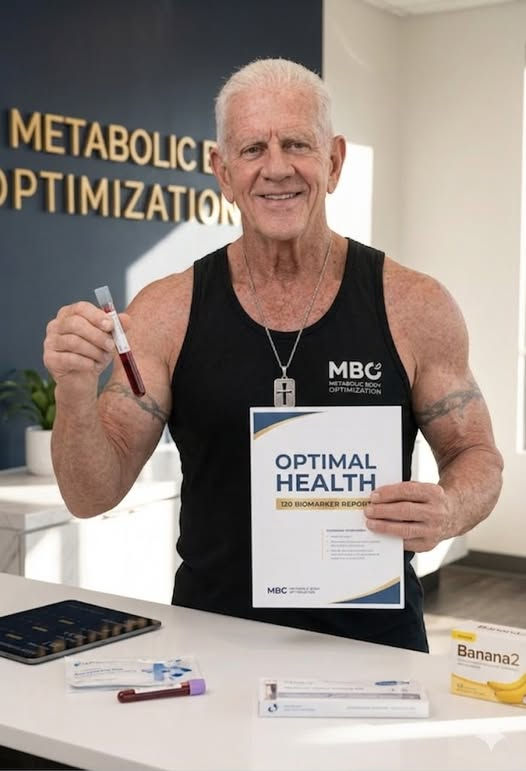
At MBO, we use body-composition measurements along with 120-biomarker blood testing to give us a much broader picture.
The Omron gives us measurable body-composition data.
Blood chemistry provides additional clues about what's happening inside the body.
Then my job as the coach is to put those pieces together with the client's history, lifestyle, nutrition, goals and actual response to the program.
That's personalization.
It's not guessing what should work.
It's measuring what is actually happening.
What 120-Biomarker Blood Testing Can Tell Us
Blood testing isn't valuable because it gives us a giant page full of numbers.
It's valuable because those numbers can reveal patterns that deserve attention.
Our comprehensive 120-biomarker blood testing can provide information involving areas such as glucose regulation, lipids, inflammation, nutrient status and hormone-related markers included in the panel.
Individual biomarkers shouldn't be treated as standalone diagnoses. They become more useful when evaluated in context with the person's medical history, lifestyle, symptoms, body composition and other relevant information.
That's the distinction I want people to understand.
I'm not looking for one magical number that explains why someone can't lose fat.
I'm looking for clues.
Maybe the body-composition numbers are changing exactly the way we want.
Maybe weight is dropping but muscle is dropping with it.
Maybe the person's blood chemistry identifies something that should be discussed with their healthcare provider.
Maybe the nutrition strategy needs adjustment.
Maybe we're getting exactly the response we wanted and shouldn't change anything.
That's why measurement matters.
Research continues to show the importance of biomarkers in understanding cardiometabolic health and the complex relationship among metabolism, inflammation, lipids and other biological systems.
But information alone doesn't change someone's body.
You have to know what to do with the information.
The Omron Provides the Numbers. Blood Chemistry Provides the Clues.
This is where the MBO system becomes different from simply getting blood work or buying a body-composition scale.
Neither one is the program.
They are tools.
The Omron allows us to track body-composition changes over time rather than relying exclusively on body weight. Bioelectrical impedance isn't a perfect laboratory measurement, and no body-composition method is perfect. Its value for us is using measurements consistently to help monitor changes within the same individual over time.
The 120-biomarker blood testing gives us another layer of information.
Then we put that information to work.
The Omron provides the numbers. Blood chemistry provides the clues. Coaching turns both into a personalized strategy.
That's the part technology can't replace.
Measurement Doesn't Create Change. Strategy Does.
You can own the best scale in the world and never change your body.
You can have 120 biomarkers tested and never change your body.
Data doesn't create results.
What you do with the data does.
That's where the personalized Glyco-Cycle® and coaching come into the process.
Instead of handing everyone the same generic diet, we build the nutrition strategy around the individual and then measure the response.
And we don't wait six months to discover whether we're headed in the wrong direction.
We reassess body composition every 21 days.
Why?
Because I want feedback.
Did we lose fat?
Did we preserve muscle?
Are the body-composition numbers moving in the direction we expected?
Does something need to change?
If the strategy is producing the response we want, we continue.
If the numbers tell us something needs attention, we adjust.
I've always believed accountability without measurement is incomplete.
It would be like telling an athlete to practice but never requiring them to show up for the game.
Every 21 days, we show up for the game.
The measurements give us a scoreboard.
The Body Leaves Clues—If You Know Where to Look
After 35 years of coaching, I've learned not to assume that two people who look similar on the outside have the same thing happening inside their bodies.
That's one of the biggest problems with generic weight-loss programs.
Same diet.
Same calories.
Same instructions.
Same expectations.
But we're not all starting from the same place.
Age, body composition, metabolic health, medications, lifestyle, training history and dozens of other variables can affect the response.
That's why the questions I care about go beyond:
“How much weight did you lose?”
I want to know:
What kind of weight did you lose?
Are we protecting muscle?
Is body fat moving in the right direction?
What does the blood chemistry tell us?
What has changed since the last assessment?
And most importantly:
What should we do next?
Those are much better questions.
Your body is constantly giving you information.
The body leaves clues.
Our job is to find them, understand them and build the strategy around the individual standing in front of us.
Frequently Asked Questions
Why is biomarker testing useful for body-composition goals?
Because body weight alone gives us limited information.
Blood testing adds another layer of information about metabolic health that can be considered alongside body composition, lifestyle, nutrition and the client's health history.
At MBO, we don't use one biomarker to make assumptions about an entire person. We look for patterns and use that information to help personalize the strategy.
How do blood biomarkers relate to fat loss and muscle preservation?
Blood chemistry can provide useful information about areas associated with metabolic health, including glucose regulation, lipids, inflammation, nutrients and hormone-related markers contained in the panel.
But blood testing is one piece of the picture.
That's why MBO combines 120-biomarker blood testing with body-composition measurement and coaching rather than relying on any single number.
What's the best way to measure body-composition progress?
There isn't one perfect body-composition measurement method. Different methods have different strengths and limitations.
For MBO, the important thing is consistent measurement over time.
We use the Omron to help monitor body-composition changes and reassess every 21 days under consistent conditions whenever possible.
We're looking for the trend, not pretending one measurement tells us everything.
Why does MBO reassess every 21 days?
Because I don't want clients spending months following a strategy without knowing what's actually happening.
The 21-day assessment gives us feedback.
If we're losing fat while protecting muscle, that's useful information.
If we're not getting the response we expected, that's useful information too.
Either way, we have something better than guessing.
Your Scale Isn't Lying. It's Just Not Telling You the Whole Story.
Weight matters.
But it's only one piece of the puzzle.
Body composition gives us more information.
Blood chemistry gives us additional clues.
Your history and lifestyle provide context.
And coaching brings those pieces together into a strategy that can change as your body changes.
That's what Metabolic Body Optimization is built around.
The Omron provides the numbers. Blood chemistry provides the clues. Coaching turns both into a personalized strategy.
And every 21 days, we measure again.
Because when your body changes, your strategy should be able to change with it.

“Learn More About MBO”


Comments