
Biomarker Testing for Sustainable Weight Loss
- Davide Pontini
- 4 days ago
- 5 min read

Table of Contents
Why Biomarker Testing Changes Everything for Weight Loss
Metabolic Adaptation and Weight Loss: Reading the Body's Response
Preserving Lean Muscle Mass While Dieting: Why the Scale Lies
Overcoming Weight Loss Plateaus Through Blood Chemistry and Body Composition
Last Updated: August 21, 2026
Why Biomarker Testing Changes Everything for Weight Loss
I've spent 35 years working with nearly 19,000 clients, and I can tell you with certainty: the scale is lying to you. When someone tells me they've "lost 15 pounds," my first question isn't "congratulations", it's "what kind of weight?" Because biomarker testing reveals something most people never see coming: you can lose 15 pounds and actually be worse off than when you started. That happens when the 15 pounds includes muscle, and it happens more often than you'd think, especially after 40.
Traditional weight loss treats the body like a simple math problem: calories in, calories out. The reality is messier. Your body doesn't care about the math; it cares about signals, hormonal, inflammatory, metabolic. When you ignore those signals and just chase a lower number on the scale, you're making decisions blind. That's where biomarker testing enters the picture. It's about understanding what's actually happening inside your body so you can preserve the muscle you need while stripping the fat you don't. The Omron provides the numbers. Blood chemistry provides the clues. Coaching turns both into a personalized strategy.
Metabolic Adaptation and Weight Loss: Reading the Body's Response
Metabolic adaptation is real, and it's one of the biggest reasons why the diet that worked five years ago doesn't work now (peer-reviewed research). Your body learns. When you restrict calories, your metabolism doesn't stay static, it adjusts downward (the NIH). Your energy expenditure drops. Your hunger hormones shift. That's not failure. That's biology.

Biomarker testing lets you see the adaptation before it becomes a wall. When I look at a client's blood chemistry, I'm reading the body's response to what they've been doing. Fasting glucose tells me how their cells are handling carbohydrates. Insulin levels show whether their pancreas is working harder than it should. Thyroid markers reveal whether metabolic slowdown is hormonal. C-reactive protein indicates whether inflammation is rising. These aren't random numbers, they're the body's way of saying "here's what's happening." The clue isn't in any single marker. It's in the pattern. One client might have elevated fasting glucose and normal insulin, which suggests a different intervention than another client with normal glucose but high insulin. That's why I measure 120 biomarkers, not five. Because the answer is rarely one isolated number.
Preserving Lean Muscle Mass While Dieting: Why the Scale Lies
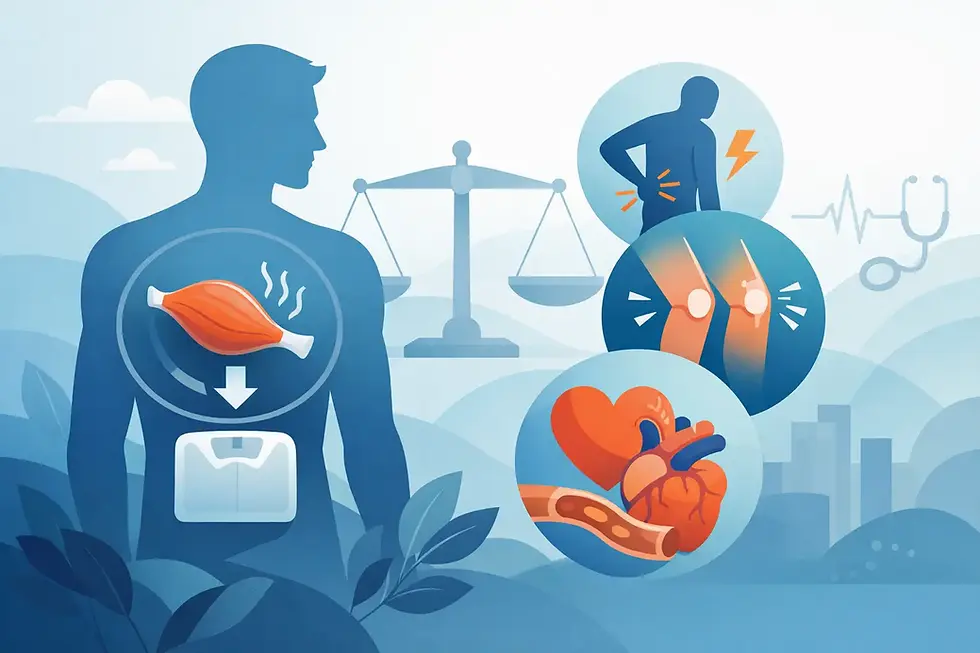
You can lose 20 pounds and gain strength. You can lose 20 pounds and lose energy. You can lose 20 pounds and end up with more visceral fat than when you started. The scale doesn't distinguish. What matters is body composition: how much of your weight is muscle, how much is fat, where the fat is distributed. Visceral fat, the fat around your organs, matters more than subcutaneous fat under your skin (peer-reviewed research).
When I use Omron body-composition analysis, I'm measuring what the scale never tells you: fat mass, lean muscle mass, visceral fat, and hydration. A client came to me after losing 30 pounds on a popular program. The scale said success. The Omron said something different: she'd lost 44 pounds of fat but also 14 pounds of muscle. Her metabolism had downshifted. Her strength had declined. Her body composition was actually worse than before, even though the number was lower. That doesn't happen by accident. It happens when the intervention doesn't account for the individual.
Overcoming Weight Loss Plateaus Through Blood Chemistry and Body Composition
Plateaus feel like failure. They're not. They're information, and they're often a sign that your strategy needs to change, not that you need to work harder at the same strategy.

When someone hits a plateau, the first instinct is usually to cut calories further or increase exercise. That's often exactly backward. A plateau usually means your body has adapted to what you're doing. That's when blood chemistry and body composition tell the real story. If your body composition is still improving, losing fat while holding muscle, then the plateau is just a temporary pause in weight loss. But if your body composition has stalled, if you're losing muscle along with fat, if your thyroid markers are dropping and your cortisol is climbing, then the strategy itself needs to change.
I had a client plateau at week 8. Her weight hadn't moved in two weeks. Her blood work told a different story: her thyroid markers were declining, her cortisol was elevated, and her body composition showed she was burning muscle. We adjusted her nutrition timing and activity pattern. Within three weeks, her body composition shifted again. That kind of adjustment only happens when you're measuring what actually matters.
Sustainable weight loss isn't about willpower or following a program perfectly. It's about measuring what's actually happening in your body and adjusting your strategy based on the individual you are, not the generic advice that works for most people. The body leaves clues. You just have to know where to look.
If you're ready to understand what's really happening in your metabolism and build a strategy based on your unique biology, schedule a complimentary Metabolic Strategy Consultation with Metabolic Body Optimization. We'll review your health history, discuss your goals, and show you exactly how biomarker testing and body-composition analysis can reveal the personalized path forward. Virtual nationwide and in-person in Vero Beach.
Frequently Asked Questions
What is the difference between weight loss and fat loss?
Weight loss is what the scale shows; fat loss is what actually matters for your body composition and metabolic health. You can lose 5 pounds and actually lose 8 pounds of fat while gaining 3 pounds of muscle—the scale stays nearly the same, but your body has changed dramatically. The Omron body-composition analysis reveals which one is happening. That's why biomarker testing paired with body-composition tracking tells the real story of what's changing inside your body, not just the number on the scale.
How do biomarkers help identify metabolic plateaus?
Metabolic plateaus often signal that your body is adapting to your current strategy—but the reason varies. Blood chemistry reveals whether insulin resistance is developing, inflammation is rising, thyroid function is shifting, or your lipid profile is changing in ways that slow fat loss. When you combine those clues with Omron body-composition data, you can see whether you're losing fat, losing muscle, or both stalling. That pattern tells me exactly what needs to change in your personalized Glyco-Cycle nutrition strategy, not just to break the plateau but to do it while protecting muscle.
Is biomarker testing worth it for weight loss?
If you've tried weight-loss methods that worked before but don't anymore—especially after 40—biomarker testing reveals why. Many people assume they need to eat less or exercise harder when the real issue is hormonal imbalance, metabolic adaptation, visceral fat accumulation, or nutrient deficiencies that generic diets don't address. The 120-biomarker blood panel combined with body-composition analysis shows what's actually happening in your body so your strategy can be personalized to your biology, not guesswork. That's the difference between struggling with another generic program and finally understanding why sustainable results require measuring what matters.
“Learn More About MBO”


Comments