
Metabolic Optimization for Men Over 50
- Davide Pontini
- 21 hours ago
- 6 min read

Table of Contents
Why Your Old Approach Stopped Working After 50
Body Composition vs Weight Loss: The Real Distinction
Metabolic Health Markers for Men: Reading the Clues
How to Fix Slow Metabolism After 40: Beyond Tools and Tactics
Last Updated: August 24, 2026
Why Your Old Approach Stopped Working After 50
I've coached nearly 19,000 clients over 35 years, and I can tell you with certainty: the approach that worked at 35 doesn't work at 50. Most men don't realize this until they've spent months frustrated, doing the same thing they always did and watching their body respond differently, or not respond at all.
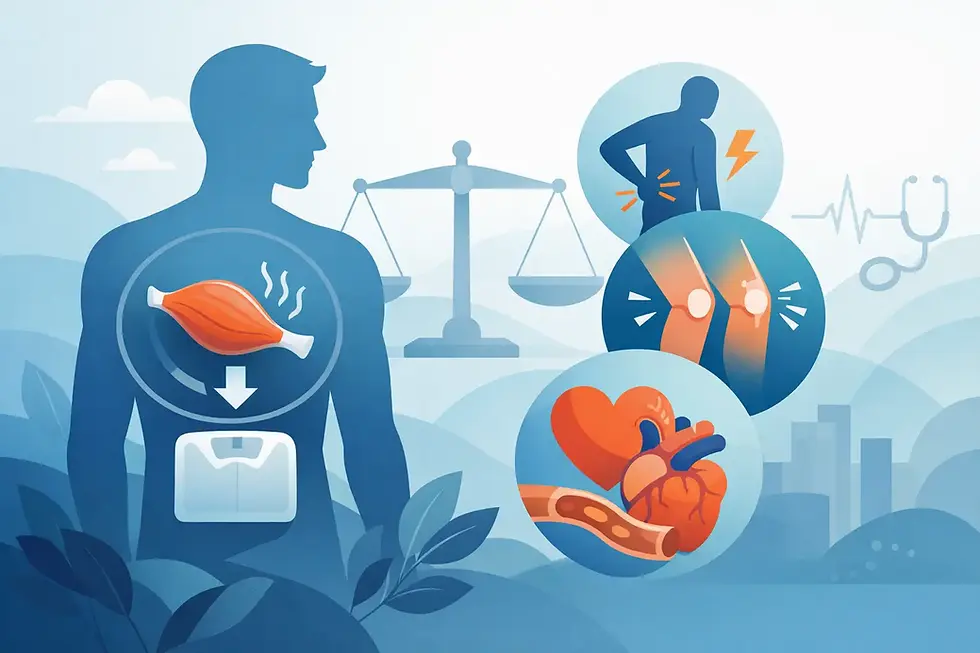
The issue isn't discipline. After 50, muscle mass declines, hormonal patterns shift, and your ability to preserve lean tissue while losing fat becomes exponentially harder without the right strategy (peer-reviewed research). Here's what most guides miss: your weight can stay the same while your body composition gets worse, or your weight can drop while you're actually losing muscle instead of fat.
That distinction, between weight loss and fat loss, is where everything changes.
Body Composition vs Weight Loss: The Real Distinction
The scale is lying to you. Not intentionally, but systematically.
A man can lose 20 pounds and feel worse, weaker, and softer because he lost muscle along with the fat. Another man can lose 15 pounds and look completely different, sharper, stronger, more defined, because he lost fat while protecting muscle. Same weight loss. Opposite outcomes.
This is why body composition matters so much after 50. When you're younger, a calorie deficit tends to preserve muscle reasonably well because your hormones still work in your favor (peer-reviewed research). After 50, that changes. A simple deficit can strip muscle aggressively, leaving you smaller and weaker even if the scale moves down.

The real goal isn't to lose weight. It's to lose fat while keeping, or building, lean muscle. That's why I use the Omron body-composition analysis, it measures fat mass, lean muscle, visceral fat, and hydration. That tells you what's actually happening. Scale weight tells you nothing.
Metabolic Health Markers for Men: Reading the Clues
Your body leaves clues. Most men never look for them.
A standard blood panel catches some things. But metabolic health markers for men over 50 require a deeper read. You need to see the pattern, not just isolated numbers. That's why the 120-biomarker blood panel matters. It's not about obsessing over every value. It's about finding the pattern that explains why your energy is tanked, why fat isn't moving, why you feel different.

Consider inflammation markers, glucose metabolism, insulin sensitivity, your lipid profile, testosterone levels, thyroid function, vitamin D and iron status (the NIH). None of these numbers mean anything in isolation. Together, they tell a story about what's actually happening in your metabolism. A man with low testosterone, high inflammation, and declining insulin sensitivity has a completely different problem than a man with normal hormones but poor sleep and chronic stress. The interventions are different. The timeline is different. The strategy is different.
This is where most approaches fail. They give you a generic program based on age, not based on what your body is actually telling you. GLP-1 medications, peptides, hormone replacement therapy, these can be useful tools when medically appropriate. But a tool without a strategy is just a tool. You need to know which problem you're actually solving.
How to Fix Slow Metabolism After 40: Beyond Tools and Tactics
The question isn't "how do I fix my slow metabolism?" It's "what's actually causing my metabolism to behave this way?"
Fixing slow metabolism after 40 requires diagnosis before intervention. A man with declining muscle mass needs a different approach than a man with hormonal imbalance. A man with poor sleep needs something different than a man with chronic inflammation. A man on a GLP-1 medication needs a completely different strategy than a man trying to lose weight through diet and activity alone.
I work with the body you actually have, not the body you think you should have. The Omron provides the numbers. Blood chemistry provides the clues. Coaching turns both into a personalized strategy.
The intervention begins immediately. Day one, your nutrition changes. Your hydration changes. Your activity pattern changes. Your accountability changes. Baseline testing informs how your strategy is personalized, but the strategy itself starts now. For many clients, this is where the Glyco-Cycle personalized nutritional system comes in, it's built around your individual metabolic clues, not a generic template.
At 21 days, we re-check your body composition. That tells us what kind of change actually happened, fat loss, muscle preservation, water weight, visceral fat reduction. That measurement guides the next adjustment. After 24 weeks of measurement, adjustment, coaching, and accountability through the 24-week Metabolic Body Optimization coaching program, your body has fundamentally changed. Not because results are slow. Because lasting change requires ongoing strategy, not a one-time prescription.
Most men think they need motivation. What they actually need is information about their own biology and someone to help them interpret it. Once you understand what's happening in your body, motivation follows.
You've tried approaches that worked before. They're not working now because your body isn't the same. The question isn't whether you can lose weight. It's whether you're willing to understand what's actually happening so you can lose fat while protecting the muscle that keeps you strong.
That's what I focus on, not generic programs, but your body, your numbers, your strategy. If you're ready to find out what's actually happening in your metabolism and what needs to change, let's talk. Book your free consultation with me and we'll review your situation together.
=== FAQ ANSWERS (audit these too, same rules) ===
[1] Q: Why is scale weight alone an unreliable indicator of health for men over 50? A: Scale weight tells you nothing about what changed, fat, muscle, water, or bone density. Two men at the same weight can have completely different body compositions and metabolic health. After 50, your metabolism and hormonal environment shift; losing muscle while dropping fat can look like progress on the scale but represents metabolic decline. That's why body composition analysis and metabolic health markers matter far more than a number.
[2] Q: How do blood biomarkers influence metabolic strategy and personalized metabolic coaching? A: A 120-biomarker blood panel reveals patterns, inflammation markers, glucose metabolism, lipid profile, hormonal balance, liver and kidney function, that explain why your body responds the way it does. One man's slow metabolism might stem from thyroid dysfunction; another's from poor insulin sensitivity or chronic inflammation. The markers provide the clues; coaching interprets them and adjusts your strategy accordingly. Without them, you're guessing.
[3] Q: Can GLP-1 medications or hormone replacement therapy replace a structured metabolic program? A: A tool is not a system. GLP-1 medications, peptides, and HRT can be valuable when medically appropriate, but they address one variable, not the whole picture. A medication suppresses appetite; it doesn't teach your body how to metabolize food, preserve muscle, or sustain results long-term without ongoing support. Lasting metabolic change requires accountability, measurement, and strategic adjustment, the work that happens between the medication and the outcome.
Frequently Asked Questions
Why is scale weight alone an unreliable indicator of health for men over 50?
Scale weight tells you nothing about what changed—fat, muscle, water, or bone density. Two men at the same weight can have completely different body compositions and metabolic health. After 50, your metabolism and hormonal environment shift; losing muscle while dropping fat can look like progress on the scale but represents metabolic decline. That's why body composition analysis and metabolic health markers matter far more than a number.
How do blood biomarkers influence metabolic strategy and personalized metabolic coaching?
A 120-biomarker blood panel reveals patterns—inflammation markers, glucose metabolism, lipid profile, hormonal balance, liver and kidney function—that explain why your body responds the way it does. One man's slow metabolism might stem from thyroid dysfunction; another's from poor insulin sensitivity or chronic inflammation. The markers provide the clues; coaching interprets them and adjusts your strategy accordingly. Without them, you're guessing.
Can GLP-1 medications or hormone replacement therapy replace a structured metabolic program?
A tool is not a system. GLP-1 medications, peptides, and HRT can be valuable when medically appropriate, but they address one variable, not the whole picture. A medication suppresses appetite; it doesn't teach your body how to metabolize food, preserve muscle, or sustain results long-term without ongoing support. Lasting metabolic change requires accountability, measurement, and strategic adjustment—the work that happens between the medication and the outcome.
“Learn More About MBO”


Comments