
9 Benefits of Professional Metabolic Coaching for Fat Loss After 40

“Coach, I’m down eight pounds. Is that good?”
My first question is, “How’s your strength?” If you’re taking the stairs more easily, your waist is coming down, and you’re still using the same weights in the gym, I want to hear about all three. If you’re skipping lunch because you have no appetite and the grocery bags feel heavier than they did a month ago, I want to hear about that, too. Eight pounds tells me how much lighter you are. It leaves the most important coaching question open: What did you lose?
In more than 35 years of coaching nearly 19,000 clients, I’ve learned that people can work hard, follow directions, and still have no practical way to judge whether the plan is doing what they hired it to do. That’s why I built Metabolic Body Optimization around a goal my clients understand: fat loss without muscle loss.
Here are nine ways professional metabolic coaching helps us work toward that goal.
1. You define what you want to keep while you lose weight
If you tell me you want to lose 25 pounds, I’ll write that down. Then I’ll ask what you want those 25 pounds to do for you. Maybe you want to get off the floor with your grandkids, finish a round of golf with energy left, or keep lifting the dumbbells you worked hard to earn.
Pick one activity you care about and describe what you can do today. That gives us a starting point. Three weeks from now, “I carried both grocery bags up the stairs without stopping” gives us something a weigh-in alone could never tell us.
2. You can track fat and muscle as your weight changes

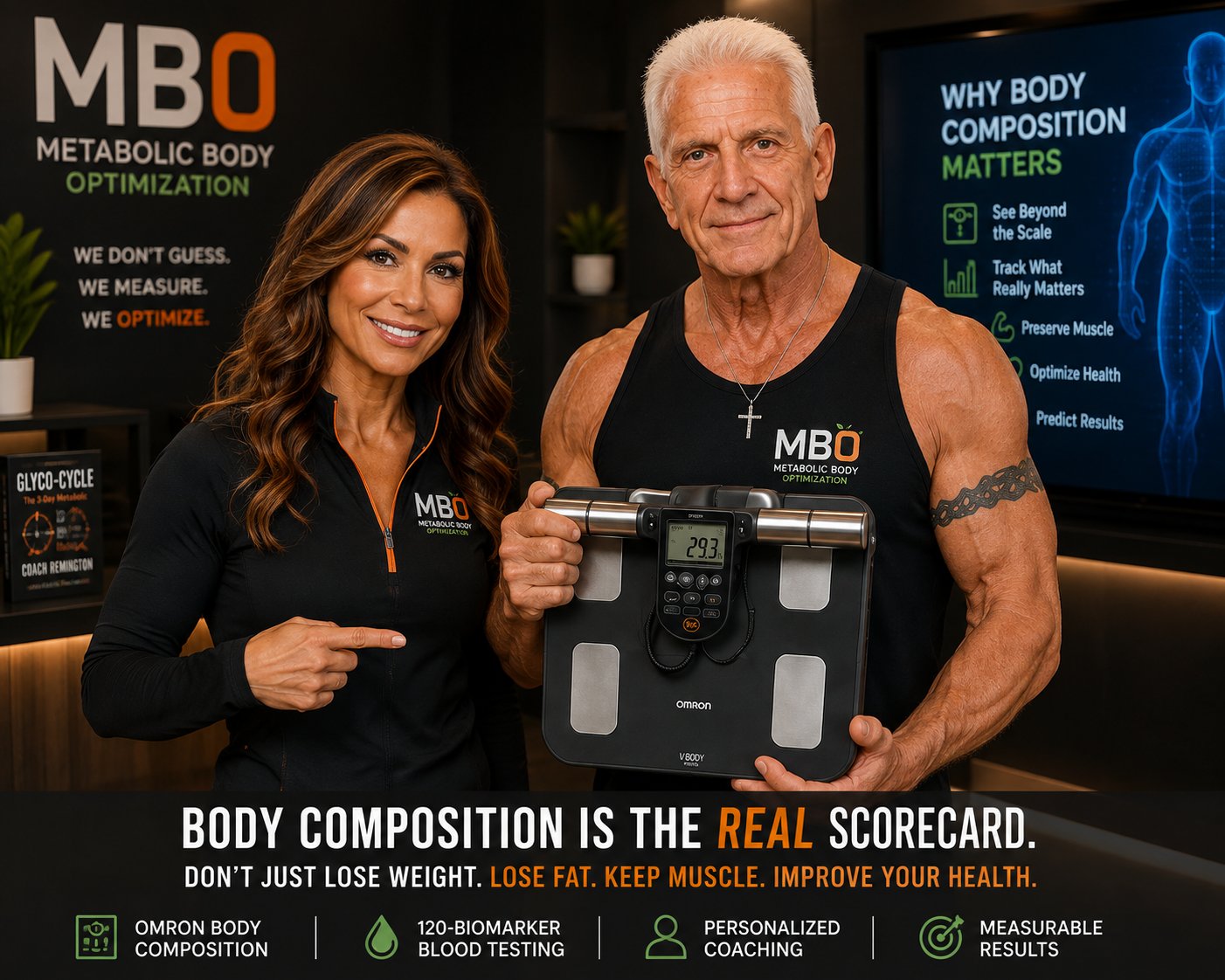
At MBO Clinic, I use Omron body-composition analysis at baseline and again at your 21-day reassessment. We follow estimates of body fat, skeletal muscle, and visceral fat alongside your weight. I ask you to take readings under similar conditions because hydration can move an individual reading. The trend becomes more useful when we can compare it with your waist measurement and your strength.
Suppose your weight holds steady for three weeks, your waist is smaller, and you can do two more repetitions with the same weight. I’d want to know that before cutting food from a plan you’re following well. That’s the practical benefit of body-composition analysis for weight loss. It can change the decision we make next.
3. You learn what each of your 120 blood biomarkers measures
Your body is leaving clues. You deserve to understand what those clues mean, especially when you’ve gone to the trouble of getting blood drawn.
Our 120-biomarker blood testing is processed by Labcorp. Through our partnership with Optimal Health Systems, you receive a detailed written explanation and a video explanation for every biomarker. You can open a result, learn what it measures and why it matters, and return to the explanation before your next appointment.
That changes the conversation. Instead of walking into your physician’s office saying, “A few things were flagged,” you can pull up a specific result and ask, “This changed from my previous test. Does it need follow-up?” In coaching, we use that education to inform our discussion about your meals and habits. Your clinician evaluates findings that may need diagnosis or treatment. Learn more about biomarker testing for body-composition goals.
4. You can make a more informed decision about supplements
Before discussing a new supplement, I want to know what’s already in your kitchen cabinet. Bring the bottles or take pictures of the labels. Tell me why you started each one and whether you’re still taking it. That list belongs in the conversation just as much as your lab report does.
Through Optimal Health Systems, we can discuss personalized supplementation after biomarker review. We start with what you eat, what the report shows, and what question a supplement is meant to address. If you take medications, your physician or pharmacist can review the proposed supplement for interactions. You should leave knowing why something was suggested and what follow-up makes sense.
5. Glyco-Cycle® gives you a meal plan you can use tomorrow
A blood report won’t tell you what to pack for a ten-hour workday. That’s where coaching earns its place.
My Glyco-Cycle® nutrition plan uses four structured meals a day and a three-day rotation. Carbohydrate portions change across two lower-carbohydrate days and one recovery day, while protein and fat stay consistent. We start with foods you eat and work out how the meals fit the hours you actually keep.
Say lunch is the meal that falls apart. You leave home at seven, your first meeting runs long, and by two o’clock you’re eating whatever is available. Our first adjustment may be as ordinary as deciding what goes in your lunch bag and when you’ll have ten minutes to eat it. Nutrition, activity, hydration, and daily habits begin on day one of the 24-week program.
6. You get muscle-preservation support if you use a GLP-1 medication
When someone taking a GLP-1 medication for weight loss tells me, “Coach, I finally have control of my appetite,” I understand why that feels like progress. Then I ask, “Which meals are you still able to finish?”
That question matters. A smaller appetite can make it harder to eat enough protein and overall nutrition. Clinical guidance supports adequate protein and progressive resistance exercise to help preserve lean mass and physical function during weight loss. One difficult workout can’t establish muscle loss, but a repeated decline in strength or recovery is worth paying attention to.
In coaching, we look at what you can comfortably eat, whether you’re getting protein across the day, and how your usual exercises feel. If nausea or persistent difficulty eating is getting in the way, that information goes back to your prescriber. Your medication is their responsibility. Helping you build meals and keep track of your strength is mine.
7. You get a decision at 21 days
A useful check-in should end with a decision you understand. At your 21-day body-composition reassessment, we put the Omron trend beside your meal notes, waist measurement, and a familiar activity or exercise. This is a body-composition review. Your clinician sets the appropriate timing for repeat blood work.
What happens next depends on what we see. If your waist is coming down, strength is holding, and the meals fit your schedule, we may keep the plan steady. If weight is falling quickly, you’re leaving meals unfinished, and your usual workout is getting harder, I want to review food intake and recovery with you. You’ll know what we’re adjusting and what to watch before we meet again.
8. You get accountability that works on a difficult week
It’s easy to follow a plan on a quiet Monday. Tell me what happened on Thursday when you were caring for a parent, driving between appointments, or eating dinner in a hotel. That’s the day we need to design for.
With online metabolic coaching, you can bring that real week to the conversation from home. If dinner went well but you missed the same afternoon meal four times, we have one specific problem to solve. You leave with an adjustment you can try the next time Thursday looks like that.
9. You learn how to judge progress for yourself
By the end of coaching, I want you to be able to answer three questions in your own words: What changed? What evidence do I have? What will I do next?
Maybe the scale hasn’t moved for ten days. Before changing everything, you know to look at your waist trend, repeat your body-composition reading under familiar conditions, and check how your strength has held up. If several things have changed, you know which records to bring to your coach or clinician. That skill stays with you after the program ends.
Start with the question your scale can’t answer
If you’re looking for metabolic coaching in Vero Beach, Florida, or online weight-loss coaching nationwide, bring me one ordinary day of meals and one activity you want to keep doing well. If you already have recent blood work or body-composition readings, we can start there, too.
Most programs measure weight. We measure outcomes. In your complimentary session, we’ll talk about what you want to lose, what you want to protect, and how we would measure both.
Frequently Asked Questions
How is metabolic coaching different from weight-loss coaching?
Weight-loss coaching typically focuses on the scale and a calorie target. Metabolic coaching looks at what is happening underneath: body composition, blood chemistry, hydration, and how your body responds to food and activity. At MBO, we use a 120-biomarker blood panel and an Omron body-composition analysis to see whether you are losing fat or muscle. Two people can lose the same 10 pounds and have completely different outcomes. The scale cannot tell you which one preserved muscle. That distinction is the core of metabolic coaching.
Can metabolic coaching help preserve muscle while losing fat?
That is the central aim. Aggressive calorie cutting often strips muscle along with fat, which slows metabolism and makes regain more likely. Across my 35+ years of clinical experience and nearly 19,000 clients, preserving lean mass is the goal that shapes the program. We track fat mass, lean muscle, visceral fat, and hydration at baseline and again at 21 days, so we know what kind of change actually occurred. The Glyco-Cycle nutritional system is built around that goal. If the 21-day re-check shows muscle loss, we adjust immediately.
How do blood biomarkers inform personalized nutrition coaching?
A standard lab report tells you whether a value is high, normal, or low. It does not tell you what that value means for your energy, your body composition, or your nutrition. Every client receives educational explanation for each of the 120 biomarkers tested. That context supports individualized nutritional coaching. Identifying a lab value is one thing; understanding its significance in the broader picture of metabolic function is another.
Is metabolic coaching a substitute for medical care?
No. Metabolic coaching is complementary to appropriate medical evaluation, not a replacement for diagnosis or treatment. Your physician manages medical conditions. What coaching adds is the layer between the lab report and daily life: how to eat, hydrate, and move in a way that supports your specific metabolic profile. If your bloodwork reveals something that needs medical attention, we refer you back to your doctor. The biomarker education we provide helps you ask better questions in that appointment, but it is not medical advice.


Comments